Latest Products
Showing posts with label Ornamental Birds. Show all posts

Kakapo

Order Detail
 
  
The Life of Animals | Kakapo | Kakapo parrots large round male measures up to 60 cm (24 inches) and weighs from 2 to 4 kg (4-9 lb) at maturity. Kakapo can not fly, having short wings for their size and lack of pronounced keel bone (sternum) that anchors the flight muscles of other birds. Unlike other species of land birds, Kakapo can accumulate a large amount of body fat for energy storage, making it the heaviest parrot. At the top of the Kakapo have yellowish green moss, or mottled feathers are prohibited, black or dark gray-brown, stirring well with native vegetation. Belly, tail, neck and face mostly yellow, streaked with pale green, slightly mottled brown-gray. Kakapo has a few feathers notable person driving fine, owl like face, so that the first European settlers called the "owl parrot". Beak surrounded by thin mustaches, or "whiskers" that birds use to test the waters to navigate, as he walks with his head down. Kakapo feet are large, scaly, and, like all parrots, zygodactyl (two toes pointing forward and two steps back). End of the tail feathers are often worn by the constant slip on the ground.


A woman can be easily distinguished from that of men: he is the head narrower and less domed, its beak is narrow and proportionately more of its ceremonies and nostrils small feet and legs are thinner and pinkish gray, and its tail is proportionately larger. It seeks to confront more and more aggressive than men when treated. Like many parrots, Kakapo has a number of challenges. Kakapo is a well-developed sense of smell, which complements its nightlife. The smell is often warns predators Kakapo largely defenseless. It seems that the Kakapo and many species of birds of New Zealand has evolved to occupy an ecological niche, usually filled with various mammalian species (marine mammals not native to New Zealand, three species of bats small). Before the arrival of humans, Kakapo were distributed in all three main islands of New Zealand. Although the Kakapo can not fly, it is an excellent climber, climbing to the tops of tall trees. A woman, he made two trips back each night during the nesting season of its nest to a food source up to 1 km (0.6 miles), and men can walk the house scene of a range of coupling to 5 km (3 miles) during the breeding season (October-January).


Young birds have a fighting game and enter the neck of a bird is often the other under his chin. Kakapo is curious by nature and are known to interact with people. Conservation staff and volunteers engaged widely with some Kakapo, which have different personalities. Kakapo was a very successful species in pre-human New Zealand and one of the reasons for this have been a lot of accessories to effectively avoid predators of local birds of prey, which are their only predators in the past. All four species rose to head the search for prey in the day and avoid the birds of prey, whose ancestors camouflage uniform and Kakapo became night. Predatory mammals, unlike birds, rely on their sense of smell and hearing to find prey and often hunt at night. The usual way for people to track down the Kakapo is the liberation of trained dogs Kakapo is the only type of parrot fly around the world, and only flightless bird that has a lek breeding system. Men are free to assemble in the arena and compete with each other to attract females. Women listen to men, because they show, or "leks They choose a mate based on the quality of its display, if not pursued by men in any way to open a pair bond is formed. Males and females meet only to mate.


Men remain in their camp during the mating season. Fight against birds may leave injury or even kill them. Kakapo is a rare bird in the world that built its current bowls are often created alongside the rocks, banks or tree trunks, to reflect the sound of the bowl itself act as amplifiers for increase the projection of the growth in male mating calls. Each bowl man linked network of trails and paths, which can range from 50 meters (160 feet) along the ridge or 20 meters (60 feet) in diameter around the hill. Men clean their bowls, and traces of debris. To attract females, males emit a strong low frequency (below 100 Hz) calls booming Cup, enlargement of the bag. After a sequence of about 20 loud explosion, a man Kakapo radiates high frequencies, metallic "ching" sound. Men are growing at an average eight hours a day, every man can produce thousands of arrows at that time. Once a woman enters the yard of one of the men, male performs display, in which he sways from side to side and makes a clicking noise with his beak. Once the birds are mated, the woman returned to his home region to lay their eggs and raise chicks. The man continues to thrive in the hope of attracting another woman. Female Kakapo lay up to three eggs per breeding cycle.


The female incubates the eggs is true, but to leave every night in search of food. Kakapo eggs usually hatch within 30 days, with fluffy gray chicks that are totally helpless. Young chicks are vulnerable to predators, like an egg, and the young were killed, many of these predators that attack adults. The men begin to grow rapidly until about 5 years. Usually, women do not seek men, until they are between 9 and 11 years. Kakapo do not breed every year, and has one of the lowest rates of reproduction in birds. Mating occurs only in years when trees mast (fruit heavily), providing an abundance of food. Rimu mast occurs only once every three to five years, and the dominant Rimu wood, such as cod in the island, Kakapo breeding occurs rarely. Another interesting aspect of breeding Kakapo is that a woman can change the sex ratio of offspring depending on its condition. A woman who eats protein-rich foods produce offspring more men (males have a weight of 3% -40% more than women). Women produce dispersion-shifted offspring sex when competition for resources (eg, food) is high and non-dispersive sex when food is abundant. Female Kakapo, will probably be able to produce eggs, even though there are a few resources, while men are more capable of Kakapo to perpetuate the species, when there are lots of things, by mating with several females . Kakapo is associated with the rich folklore traditions and beliefs of Maori. Irregular cycle of breeding birds to understand because of the heavy fruiting or "rigging" the events of different types of plants such as Rimu Maori, which led to credit the bird with the ability to predict the future.

Magpie

Order Detail
  
The Life of Animals | Magpie | Magpies are passerine birds of the crow family, Corvidae. In Europe, "magpie" is Often used by English speakers as a Synonym for the European Magpie, as there are no other Magpies in Europe outside Iberia. According to analysis, the Magpies do not form monophyletic group Traditionally They are believed to be a long tail Certainly has elongated (or shortened) independently in multiple lineages of corvid birds.

Among the traditional Magpies, there Appear to be two distinct lineages: one consists of Holarctic species with black / white coloration and is probably closely related to Eurasian Crows and jays.


The Azure-winged Magpie is a species with a most peculiar distribution and unclear relationships. Either the North American, Korean, and remaining Eurasian forms are accepted as three or four separate species, or there exists only a single species, Pica pica.

Lark

Order Detail
  
The Life of Animals | Lark | Larks are small to medium-sized birds, 12 to 24 cm (5 to 8 inches) in length and 15 to 75 grams (0.5 to 2.6 ounces) in weight (Kikkawa 2003). They have more elaborate than most birds calls, and Often given extravagant songs in display flight (Kikkawa 2003). Most species build nests on the ground, usually cups of dead grass, but in some species more complicated and partly domed. A few desert species nest very low in bushes, so Perhaps circulating water can cool the nest. Larks' eggs are usually speckled, and clutch sizes range from 2 (ESPECIALLY in species of the driest deserts) to 6 (in species of temperate regions). Larks incubate for 11 to 16 days (Kikkawa 2003). Like many ground birds, most species have long Lark Hind claws, the which are thought to Provide stability while standing.


Many species dig with Their bills to uncover food. Some Larks have heavy bills (reaching an extreme in the Thick-billed Lark) for cracking open seeds, while others have long, down-curved bills, the which are ESPECIALLY Suitable for digging (Kikkawa 2003). Larks are the only passerines That Their lose all feathers in their first moult (in all species Whose first moult is known).


In many respects, Including tertial long feathers, Larks resemble other ground birds Such as pipits. Larks are a well-defined family, partly Because of the shape of Their tarsus (Ridgway 1907). For instance, the American Ornithologists' Union places just after the Crows Larks, shrikes, and vireos. At a finer level of detail, some now place the Larks at the beginning of a superfamily Sylvioidea with the swallows, Various' Old World warbler "and" Babbler "groups, and others (Barker et al., 2002, Alstrom et al. 2006) . Larks, commonly consumed with bones intact, have Historically been Considered wholesome, delicate, and light gaming.


Lark's Tongues were particularly highly valued. In modern times, shrinking habitats Lark made meat rare and hard to come by, though it can still be found in Italy and elsewhere in Restaurants in Southern Europe (Hooper).

Australian King Parrot

Order Detail
  
The Life of Animals | Australian King Parrot | The Australian King Parrot (Alisterus scapularis) is endemic to eastern Australia. The adult male has a red head, breast, and lower undersides, with a blue band on the back of the neck above the between the red and green on the back, the wings are green and each shoulder has a pale green band, the tail is green, and the rump is blue. The male has a reddish-orange upper mandible with a black tip, a black lower mandible base with an orange, and yellow irises. Both sexes of juveniles have a Yellowish brown irises and beak, and Otherwise resemble the female


Smaller in length. Australian King Parrots range from North and Central Queensland to Southern Victoria. They are frequently seen in small groups with Various species of Rosella. Further from Eastern Upland Their normal habitat, They are also found in Canberra During winter, the outer western suburbs and north shore of Sydney, and the Carnarvon Gorge in Central Queensland. Their native to Australia, King Parrots are occasionally Bred in aviaries and Kept as Relatively calm and quiet household pets if hand-raised. They are Relatively unknown outside Australia.
  

Bronze Winged Parrot

Order Detail
  
The Life of Animals | Bronze Winged Parrot | The Bronze-winged Parrot (Pionus chalcopterus) is a medium sized parrot pionus 28 cm (11 in) long. It has short red undertail feathers. The rump, tail and wings are dark blue with lighter blue underwings. The head is dark blue-green; the mantle, back and underparts are dark bronze-green with some blue-tipped feathers and Sometimes Scattered red feathers. Its beak is pale yellow. In adults the ring of bare skin around the eyes is pink. Juveniles have whitish eyerings and Their underparts are brownish


The Bronze-winged Parrot is found in far western Venezuela, western and central Columbia, western Ecuador and far north-western Peru. Generally it prefers the canopy of Forest and Woodland (both humid and semi-deciduous), but also Occurs in adjacent habitats with tall trees. The Bronze-winged Parrot Nests in tree cavities.
  

Blue Throated Macaw

Order Detail
  
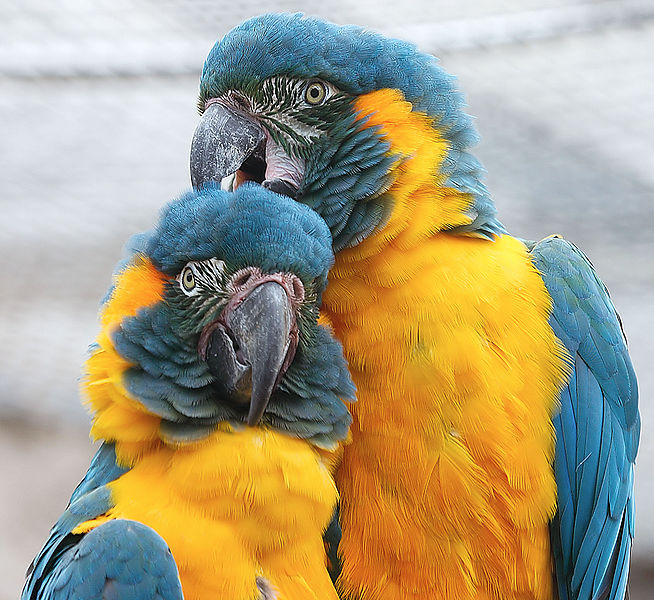
The Life of Animals | Blue Throated Macaw | The Blue-throated Macaw (Ara glaucogularis; Previously caninde Ara) is a macaw endemic to a small area of north-central Bolivia known as Los Llanos de Moxos. Recent population estimates and range of about 100-150 individuals Suggests That Remain in the wild. It has vivid colors with turquoise-blue wings and tail, and bright yellow underparts and blue undertail coverts. The throat is blue and continuous with its blue cheeks. It has a large black bill. Bare skin at the base of the beak is pink and pale bare skin on the sides of the face is partly covered with lines of small dark blue feathers. The adults have yellow irises and the juveniles have brown irises It can be separated from the slightly larger Blue-and-yellow Macaw by the blue (not black) throat, the blue (not green) forehead and the lack of contrast the between the remiges and upperwing coverts.


In the wild the Blue-throated Macaw Often competes for nesting-holes in trees with the Blue-and-yellow macaws, toucans and large woodpeckers. Other projects have been started to protect the remaining wild population, but at present are still Decreasing numbers. In the wild, within the Palm Groves of Bolivia, birds nest in tree hollows created in dead palm trunks, rotten knots, holes and Dead Limbs of trees.


Blue-throated Macaws overall are early nesters and utilize the resources of these rare nest holes before the other Macaws overall are in breeding condition. is listed on the IUCN Red List as Critically Endangered 


Pohnpei Lorikeet

Order Detail
 
  
The Life of Animals | Pohnpei Lorikeet | The Pohnpei Lorikeet (Trichoglossus rubiginosus) is a monotypic species of parrot in the Psittacidae family. It is endemic to the island of Pohnpei and the nearby Ahnd in Micronesian Atoll.


The plumage is reddish-maroon Mainly with Vague approximately transverse striations of darker maroon. The head a slightly darker maroon. The male has an orange beak and yellow-orange irises, while the female has a yellow beak and light gray irises. The juveniles have brown beaks and brown irises. Its natural habitat is tropical moist forests Lowland and Plantations.
  

Golden Parakeet

Order Detail
 

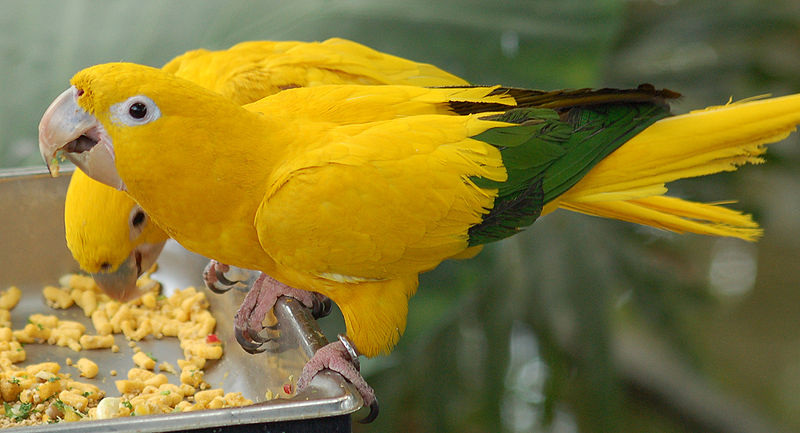
The Life of Animals | Golden Parakeet | The Golden Parakeet or Conure Golden Guaruba guarouba, formerly classified as Aratinga guarouba is a species of neotropical parrot.  It is a protected species listed on CITES appendix I The Golden Parakeet is Mainly yellow with green in the outer wings and with an all-yellow tail. It has a large horn-colored beak, pale-pink bare eye-rings, brown irises, and pink legs. Male and female have identical external appearance


Juveniles are duller and have less yellow and more green plumage than the adults. The juvenile's head and neck are Mostly green, the back is green and yellow, the upper side of tail is Mostly green, the breast is greenish, the eye-rings are pale-gray, and the legs are brown The Golden Parakeet is distributed in the northern parts of Brazil. The birds studied for a 1986 study used two different habitats During the year: During the non-breeding season, the which coincided with the dry season, They occupied the tall forest.


Golden Parakeets are a Sociable species, living, feeding, sleeping and even breeding together They eat fruits, flowers, buds, seeds, and cultured maize in the wild.  The Golden Parakeet has a breeding system that is almost unique amongst parrots, ace pairs are aided by a number of helpers the which aid in the raising of the young This behavior is less common with parakeets in captivity, WHO Often Their young abandoned after three weeks


After the Golden Parakeet reaches sexual maturity at the age of three years, the breeding season starts in November and runs through February. They nest in a high tree, in deeper than average nesting cavities, and lay an average of four 37.1-by-29.9-millimeter (1:46 by 1:18 in) eggs, the which They aggressively guard. In captivity, breeding Golden Parakeets Will resume Pls Their chicks are taken from Them. At birth, the Golden Parakeets are covered in white down That eventually turns darker within a week.  


Dusky Lory

Order Detail
  
The Life of Animals | Dusky Lory | The Dusky Lory (Pseudeos fuscata) is a monotypic species of parrot in the Psittacidae family, and the only species of the genus Pseudeos Alternative common names are the White-rumped Lory-orange or the Dusky Lory It is found in Indonesia and Papua New Guinea .


The Dusky Lory is short-tailed parrot about 25 cm (10 in.) long. Juveniles are duller with a back and rump Yellowish, Yellowish-gray irises, and a beak That Is yellow at the base and brown / black Towards the tip. It is also native to the nearby Indonesian islands of Salawati and Yapen


Yellow Bibbed Lory

Order Detail
  
The Life of Animals | Yellow-bibbed Lory | The Yellow-bibbed Lory (Lorius chlorocercus) is a monotypic species of parrot in the Psittacidae family it is endemic to the Solomon Islands.


The Yellow-bibbed Lory is 28 cm (11 in) long. It has blue / green thighs and dark-gray legs. It has an orange-red beak, dark-gray eyerings, and orange irises. 


The Yellow-bibbed Lory is endemic to the eastern Solomon Islands Its natural habitats are subtropical or tropical moist Lowland forests and subtropical or tropical moist Montanes. 


Eclectus Parrot

Order Detail
  
The Life of Animals | Eclectus Parrot | The Eclectus Parrot, Eclectus roratus, is a parrot native to the Solomon Islands, Sumba, New Guinea and nearby islands, northeastern Australia and the Maluku Islands (Moluccas). It is unusual in the parrot family for its extreme sexual dimorphism of the colours of the plumage; the male having a mostly bright emerald green plumage and the female a mostly bright red and purple/blue plumage. Joseph Forshaw, in his book Parrots of the World, noted that the first European ornithologists to see Eclectus Parrots thought they were of two distinct species. Large populations of this parrot remain, and they are sometimes considered pests for eating fruit off trees.


Ornithologists usually classify the Eclectus Parrot as a member of tribe Psittaculini in the Psittacidae family of order Psittaciformes. The Eclectus Parrot is the most sexually dimorphic of all the parrot species.  Although the Eclectus Parrot is the only extant species in the genus Eclectus, fossil remains of another species, Oceanic Eclectus Parrot (Eclectus infectus), have been found in archaeological sites in the islands of Tonga and Vanuatu  The species presumably existed in Fiji as well. E. infectus had proportionally smaller wings than the Eclectus Parrot. 


There are nine (possibly more) subspecies of Eclectus Parrots, although the species as a whole needs reviewing. The Eclectus Parrot is unusual in the parrot family for its marked sexual dimorphism in the colours of the plumage. The male is mostly bright green with a yellow-tinge on the head. It has blue primaries, and red flanks and underwing coverts. Its tail is edged with a narrow band of creamy yellow, and is dark grey edged with creamy yellow underneath, and the tail feathers are green centrally and more blue as they get towards the edges. The Grand eclectus female is mostly bright red with a darker hue on the back and wings. The beak of the adult female is all black. Adults have yellow to orange irises and juveniles have dark brown to black irises. The upper mandible of both male and female juveniles are brown at the base fading to yellow towards the biting edges and the tip


The abdomen and nape of the females are blue in most subspecies, purple abdomen and nape in the subspecies from the north and central Maluku Islands (roratus and vosmaeri), and red abdomen and nape in the subspecies from Sumba and Tanimbar Islands (cornelia and riedeli). Females of several subspecies have a yellow-tipped tail; taken to the extreme in riedeli and vosmaeri which also have yellow undertail coverts. The female vosmaeri displays the brightest red of all the subspecies, both on the head and body


The diet of the eclectus in the wild consists of mainly fruits, wild figs, unripe nuts, flower and leaf buds, and some seeds. In captivity, they will eat most fruits including mangos, figs, guavas, bananas, any melons, stone fruits (peaches etc.), grapes, citrus fruits, pears and apples. In captivity the eclectus parrot does benefit from a variety of fresh fruits and vegetables, leafy greens such as endive and dandelion, as well as a variety of seeds, including spray millet, and a few nuts such as shelled almonds and shelled walnuts.


In its natural habitat, the Eclectus nests within hollows in large, emergent rainforest trees. Unlike other parrot species, Eclectus parrots are polygyny—females may mate with multiple male suitors and males may travel from nesting site to nesting site to mate with multiple females. The male is primarily a green color, likely for the purpose of camouflage amongst the trees whilst foraging. Although Eclectus Parrots may reach sexual maturity earlier or later, they usually reach it between 2-3 years It is often possible to place abandoned eggs from other parrot species beneath a broody Eclectus hen, which she will readily accept and then happily incubate to the point of hatching.


Adult females with poor nest hollows often commit infanticide on male, if they laid a male and a female chick. Eclectus parrots are one of the more popular birds kept in captivity, as either parent or hand reared. Unlike many other species of parrot they are relatively easy to breed yet difficult to hand feed. Eclectus in captivity require vegetables high in beta-carotene, such as lightly cooked sweet potato, fresh broccoli clumps, and fresh corn on the cob. As with all pet birds, they should not be fed avocado, chocolate, or high fat junk foods such as French fries or commercially processed human foods such as pizza. Spray millet is one of the seed items they enjoy, though the Eclectus diet should typically contain much less seed than other birds. Nuts and seeds provide vitamin E, but should be limited in order to avoid too much fat in the diet, as Eclectus parrots can Fortified or artificially colored food items may also cause allergic reactions in some individuals, including severe itchiness leading to feather and skin damage. Eclectus Parrots are generally calm birds in captivity, displaying a pensive nature when faced with novel items or situations which may give rise to the mistaken impression that the species is 'dull-witted' The Eclectus may also exhibit a more neophobic nature than other species of companion bird Eclectus parrots are prone to feather destruction (picking, pulling, cutting and or barbing) in captivity. The average lifespan of the eclectus parrots in captivity is unknown, since these birds have not been kept in captivity in great numbers until the nineteen eighties.

 
Support : Creating Website | Johny Template | Mas Template
Copyright © 2011. Stock Image - All Rights Reserved
Template Created by Creating Website Published by Mas Template
Proudly powered by Blogger