Latest Products
Showing posts with label Snake. Show all posts

Flying Snake

Order Detail
 

The Life of Animals | Flying Snake | Chrysopelea also below their assigned common name "flying snakes" known. He slides his balance comb over his belly and slid against the rough bark of tree trunks, making up a tree. The combination of sucking in your stomach and make a lateral move to the curve in the air makes the snake can float in the air, which can save energy from the earth and terrestrial predators Dodge limited concave bearing surface that creates long journey suction snake flattens the stomach body to twice the width of the back of the head to the anal hole is near the end of the tail of the snake, making the cross section of the body of the snake resemble sectional through a cross Frisbee or flying saucer.


When a flying disk revolutions in the air, resulting in increased projecting section concavity air pressure to the center of the disc, to raise the flying disc. A snake is continuously moved in lateral undulation for the same effect of increasing the air pressure below the arcuate body to create a slide. Flying snakes are able to glide better than flying squirrels and other gliding animals, despite the absence of limbs, wings, wing extensions or other, glide through the forest and jungle life with a distance as great as 100 m. There are five recognized species of flying snake, found in western India Indonesian archipelago.


It is a bit poisonous snakes ", but its small and fixed rear teeth that make them dangerous to humans Golden tree snake or ornate flying snake, adorned Chrysopelea (Shaw, 1802) This result is the largest species of snake fly, up to four meters long. Although it is the golden tree snake, there are other colors, for example, tend to have a few steps toward the thin lime green pure yellow, while in India, the IT-orange red marks and small black bars back, rich colors almost paradise tree snake. Paradise tree snake, Paradisi Chrysopelea Boie and Boie, 1827 This species of flying snake fields of up to three meters long and is very popular in the pet trade in Europe. Their bodies are black, but covered with rich green scales. Tree Band snake or flying serpent, Chrysopelea Pelias (Linnaeus, 1758) Twin-Lock: This is the smallest species of flying snakes up to two meters long. Though small, it is certainly one of the rarest species of flying snakes in the range.  

Find The Life of Animals

Black Mamba

Order Detail
 
  
The Life of Animals | Black Mamba | snake in Africa, averaging around 2.5 meters (8.2 ft), and Sometimes growing up to 4.3 meters (14 ft). The eastern green mamba, Dendroaspis angusticeps, and the black mamba, Dendroaspis polylepis were the resource persons Considered a single species until 1946 Pls Dr. Vivian Fitzsimons Them split into separate species. The snake's scientific name is Dendroaspis polylepis: Dendroaspis meaning "tree asp ', and polylepis meaning" many scaled. " The name "black mamba" is given to the snake not Because of its body color but Because of its ink-black mouth.


The black mamba's back skin color is olive, brownish, gray, or khaki Sometimes the adult snake's length is on average 2.5 meters (8.2 ft) but some specimens have reached lengths of 4.3 to 4.5 meters (14 to 15 ft). Black mambas weigh about 1.6 kilograms (3.5 lb) on average. The black mamba lives in Africa, occupying the following range: Northeast Democratic Republic of the Congo, Southwestern Sudan to Ethiopia, Eritrea, Somalia, Kenya, Eastern Uganda, Tanzania, southwards to Mozambique, Swaziland, Malawi, Zambia, Zimbabwe and Botswana to KwaZulu -Natal in South Africa, and Namibia; then northeasterly through Angola to the Southeastern Zaire The black mamba is not commonly found above altitudes of 1000 meters (3280.8 feet), although the distribution of the black mamba does reach 1800 meters (5905.5 feet) in Kenya and 1650 meters (5413.3 feet) in Zambia. The black mamba has adapted to a variety of climates ranging from savanna, woodlands, rocky slopes, dense forests and even humid swamps of The Grassland and savanna Woodland / shrubs That extends through the central, eastern and southern Africa are the black mamba's typical habitat of the black mamba prefers more arid environments Woodland Such as light, rocky outcrops, dry and semi-arid bush country.

The black mamba uses its speed to escape threats, not to hunt prey. The venom of the black mamba Mainly consists of potent neurotoxins. With a LD50 of 12:25 mg/kg-0.32 mg / kg, the black mamba's venom is virulently toxic. Although only 10 to 15 mg is deadly to a human adult, its bite delivers about 100-120 mg of venom on average but They can deliver up to 400 mg of venom in a single bite Potentially Black mamba bites can kill a human within 20 hours or less Depending on the nature of the bite and the area Bitten, but Death Occurs usually after 30-60 minutes on average, Sometimes even taking up to three hours. Presently, there is a polyvalent antivenom produced by SAIMR (South African Institute for Medical Research) to treat all black mamba bites from different localities.


When warding off a threat, the black mamba delivers multiple strikes, injecting large amounts of virulently toxic venom with each strike, landing Often bites on the body or head, unlike other snakes. Also, the black mamba's venom has been known to cause paralysis. Many herpetologists, including South African-born herpetologist Austin Stevens, the black mamba regard as one of, if not the most dangerous and feared snakes in the world due to Various factors including the toxicity and high yield of its venom, its high level of aggression , it's speed, agility, size, and other factors. Mongooses are the main predators of the black mamba. They usually prey on young snakes and eggs. Mongooses are notable for Their resistance to snake toxins. Cape file snakes are also predators of young black mambas.


Daboia

Order Detail
 
  
The Life of Animals | Daboia | Daboia is a monotypic genus of venomous Old World viper. The single species, D. russelii, is found in Asia throughout the Indian subcontinent, much of Southeast Asia, southern China and Taiwan. The species was named in honor of Patrick Russell (1726–1805), a Scottish herpetologist who first described many of India's snakes; and the genus is after the Hindi name meaning "that lies hid", or "the lurker." This snake can grow to a maximum length of 166 cm (5.5 ft) and averages about 120 cm (4 ft) on mainland Asian populations, although island populations do not attain this size. Ditmars (1937) reported the following dimensions for a "fair sized adult specimen"


The head is flattened, triangular and distinct from the neck. The snout is blunt, rounded and raised. The nostrils are large, in the middle of a large, single nasal scale. The supranasal has a strong crescent shape and separates the nasal from the nasorostral anteriorly. The supraocular scales are narrow, single, and separated by 6–9 scales across the head. The eyes are large, flecked with yellow or gold, and each is surrounded by 10–15 circumorbital scales. There are 10–12 supralabials, the 4th and 5th of which are significantly larger. There are two pairs of chin shields, the front pair of which are notably enlarged. The fangs attain a length of 16 mm in the average specimen. The dorsal scales are strongly keeled; only the lower row is smooth. Mid-body, the dorsal scales number 27–33. The ventral scales number 153–180. The tail is short — about 14% of the total body length — with the paired subcaudals numbering 41–68 The color pattern consists of a deep yellow, tan or brown ground color, with three series of dark brown spots that run the length of its body. The dorsal spots, which usually number 23–30, may grow together, while the side spots may break apart. Behind the eye, there is a dark streak, outlined in white, pink or buff. The venter is white, whitish, yellowish or pinkish, often with an irregular scattering of dark spots.
  
The snake is mostly found in open, grassy or bushy areas, but may also be found in second growth forests (scrub jungles), on forested plantations and farmland. Terrestrial and active primarily as a nocturnal forager. The identity of this sensor is not certain, but the nerve endings in the supranasal sac of these snakes resemble those found in other heat-sensitive organs. The quantity of venom produced by individual specimens is considerable. Reported venom yields for adult specimens range from 130–250 mg to 150–250 mg to 21–268 mg. For 13 juveniles with an average length of 79 cm, the average venom yield was 8–79 mg (mean 45 mg) The LD50 in mice, which is used as a general indicator of snake venom toxicity, is as follows: 0.08–0.31 μg/g intravenous, 0.40 μg/kg intraperitoneal, 0.75-1.6 mg/kg subcutaneous For most humans, a lethal dose is approximately 40–70 mg. Venom toxicity and bite symptoms in humans varies within different populations and over time Envenomation symptoms begin with pain at the site of the bite, immediately followed by swelling of the affected extremity. Blistering occurs at the site of the bite, developing along the affected limb in severe cases. Necrosis is usually superficial and limited to the muscles near the bite, but may be severe in extreme cases. Vomiting and facial swelling occurs in about one-third of all cases Kidney failure (renal failure) also occurs in approximately 25-30 percent of untreated bites. Severe disseminated intravascular coagulation also can occur in severe envenomations. 

If swelling up to the trunk occurs within 1–2 hours, massive envenomation is likely. Discoloration may occur throughout the swollen area as red blood cells and plasma leak into muscle tissue Death from septicaemia, kidney, respiratory or cardiac failure may occur 1 to 14 days post-bite or even later This test is often referred to as Dilute Russell's viper venom time (dRVVT). The coagulant in the venom directly activates factor X, which turns prothrombin into thrombin in the presence of factor V and phospholipid. The venom is diluted to give a clotting time of 23 to 27 seconds and the phospholipid is reduced to make the test extremely sensitive to phospholipid. The dRVVT test is more sensitive than the aPTT test for the detection of lupus anticoagulant (an autoimmune disorder), because it is not influenced by deficiencies in clotting factors VIII, IX or XI In India, the Haffkine Institute prepares a polyvalent antivenin that is used to treat bites from this speciesAt birth, juveniles are 215–260 mm in length. 


King Cobra

Order Detail

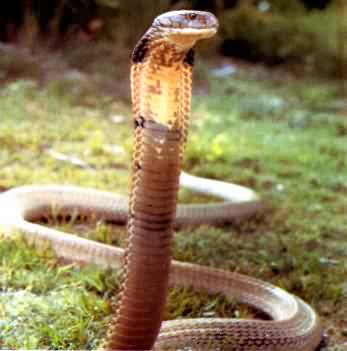
The Life of Animals | King Cobra | The king cobra (Ophiophagus hannah) is the world's longest venomous snake, with a length up to 5.6 m (18.5 ft).  This species, which preys chiefly on other snakes, is found predominantly in forests from India through Southeast Asia to the Philippines and Indonesia. Despite the word "cobra" in its name, this snake is not a member of Naja ("true cobras") but belongs to its own genus. The king cobra can be highly aggressive and agile, delivering a large quantity of highly potent venom in a single bite. The King Cobra is a large and powerful snake, averaging 3 to 4 meters (9.8 to 13 ft) in length and typically weighing about 6 kilograms (13 lb). The head of a mature snake can be quite massive and bulky in appearance, though like all snakes, they can expand their jaws to swallow large prey items The male is larger and thicker than the female. The average lifespan of a king cobra is about 20 years.


The king cobra is the sole member of genus Ophiophagus, while most other cobras are members of the genus Naja. They can be distinguished from other cobras by size and hood marks. King cobras are generally larger than other cobras, and the stripe on the neck is like the symbol "^" instead of a double or single eye(s) shape that may be seen in most of the other Asian cobras. The king cobra is distributed across South Asia, Southeast Asia, and the southern areas of East Asia (southern China) where it is not common. King cobra populations have dropped in some areas of its range because of the destruction of forests.

When the scent of a meal is detected, the snake flicks its tongue to gauge the prey's location (the twin forks of the tongue acting in stereo); it also uses its keen eyesight (king cobras are able to detect moving prey almost 100 m [300 feet] away), intelligence and sensitivity to earth-borne vibration to track its prey Following envenomation, the king cobra will begin to swallow its struggling prey while its toxins begin the digestion of its victim. King cobras, like all snakes, have flexible jaws. The jaw bones are connected by pliable ligaments, enabling the lower jaw bones to move independently, enabling the King cobra to swallow its prey whole. The expansion of the jaw enables the snake to swallow prey much larger than its head.

The snake strikes rapidly and the attack range can be as far as 2 meters. The king cobra can deliver multiple bites in a single attack but adults are known to bite and hold on In spite of being a highly dangerous snake, it prefers to escape first unless it is cornered or provoked. If a king cobra encounters a natural predator, such as the mongoose, which has some resistance to the neurotoxins the snake generally tries to flee. If unable to do so, it forms the distinctive cobra hood and emits a hiss, sometimes with feigned closed-mouth strikes. The venom of the king cobra consists primarily of neurotoxins, but it also contains cardiotoxic and some other compounds.Moreover, king cobra envenomation is clinically known to cause renal failure Little is known about its venom. In the past, the in mice of the king cobra venom was treated as 1.6 mg/kg – 1.8 mg/kg, making it's venom one of the least potent among the elapids. Besides, this species is capable of delivering a large quantity of venom, injecting a 200-600 mg dose on average. A single bite from the king cobra can cause the death of an adult human in 15 minutes, though the average death time recorded is between 30–45 minutes after envenomation. It is regarded as one of the deadliest snakes.


There are two types of antivenom made specifically to treat king cobra envenomations. In Thailand, a concoction of alcohol and the ground root of turmeric is ingested, which has been clinically shown to create a strong resilience against the venom of the king cobra, and other snakes with neurotoxic venom The king cobra is unusual among snakes in that the female king cobra is a very dedicated parent. The baby king cobras, with an average length of 45 to 55 centimeters (18 to 22 in), have venom which is as potent as that of the adults.

Philippine Cobra

Order Detail
  
The Life of Animals | Philippine Cobra | The Philippine Cobra (Naja philippinensis) is a stocky, highly venomous spitting cobra native to the Philippines.  Fairly stockily built. Pattern: adults uniformly light or medium brown, occasionally some lighter variegations; juveniles dark brown, with lighter variegations, sometimes a dark band behind the throat. The Philippine cobra can be found on the islands of Luzon, Mindoro, Catanduanes, Samar, Eastern Samar, Southern Leyte and Masbate.


Philippine Cobra’s habitat include open fields, human settlements and dense jungle. The snake feeds predominantly on small mammals. The venom of the Philippine cobra is a neurotoxin which affects cardiac and respiratory function and can cause neurotoxicity and respiratory paralysis(the postsynaptic neurotoxins interrupt the transmission of nerve signals by binding to the neuro-muscular junctions near the muscles). The symptoms might include headache, nausea, vomiting, abdominal pain, diarrhoea, dizzyness, collapse, convulsions. Complete respiratory failure leads to victim's death. The cobra can spit its venom up to ten feet and cause permanent blindness.


The Philippine cobra has the most potent venom (drop by drop) among the species from the Naja genus.


Common Krait

Order Detail

The Life of Animals | Common Krait | The common krait (Bungarus caeruleus) is a type of krait that is found in the jungles of the Indian sub-continent. This snake is highly venomous, and is one of the "big four" snakes in India. The body colour varies from a dark steely blue-black to a pale faded bluish grey. It has large hexagonal scales running down its spine.  Young are known to eat arthropods. As per Daniels, the common krait feeds primarily on other snakes, including "blind worms" (snakes of the genus Typhlops) and other kraits, and also feeds on frogs and lizards and small mammals. This snake is nocturnal.


In balled condition, the snake allows considerable handling, however, over handling often instigates bites. At night the snake is very active, escapes by hissing loudly, or keeping still, occasionally biting the source of the annoyance. When agitated, it will coil up with head concealed, body flattened, and make jerky movements. May also lift its tail. Reluctant to bite, but when it does bite, it typically bites and holds on for awhile, which enables it to inject considerable amounts of venom. The untreated mortality rate from its bites can be very high. This snake is regarded as one of the most dangerous Bungarus species.

The Indian krait's venom consists of neurotoxic which induces muscle paralysis. Clinically, their venom contains pre-synaptic neurotoxins. There is frequently little or no pain from a krait bite and this can provide false reassurance to the victim. Typically, victims complain of severe abdominal cramps, accompanied by progressive paralysis. This allow for gentle transport to medical facilities, where the venom can be treated when the bandage is removed. It is also possible to support bite victims via mechanical ventilation, using equipment of the type generally available at hospitals. Often in rainy season the snakes come out of their hiding places and find refuge on dry places inside a house. if bitten by it in sleep the victim seldom comes to know as the bite feels more like an ant bite or a mosquito bite. The victim can well be dead before he even wakes up.  In the famous story in The Jungle Book, "Rikki Tikki Tavi," Karait, a dustbrown krait, threatens the boy.

Taipan Snake

Order Detail
 
  
The Life of Animals | Taipan Snake | There are three known species: the coastal taipan (Oxyuranus scutellatus), the inland taipan (Oxyuranus microlepidotus) and a recently discovered third species, the Central Ranges taipan (Oxyuranus temporalis). The coastal taipan has two subspecies: the coastal taipan (Oxyuranus scutellatus scutellatus), found along the north-eastern coast of Queensland and the Papuan taipan (Oxyuranus scutellatus canni), found on the southern coast of Papua New Guinea.


One species, the inland taipan (Oxyuranus microlepidotus), which is endemic to Australia, has the most toxic venom of any terrestrial snake species worldwide. Pseudonaja textilis intervenes between the inland and coastal taipan (Oxyuranus scutellatus) which has the third most toxic venom of any land snake. The venom clots the victim's blood, blocking blood vessels and using up clotting factors.

The coastal taipan (Oxyuranus scutellatus) is considered as the third most venomous land snake in the world based on LD50, and arguably the largest venomous snake in Australia.Taipans can grow to 3 meters long. The coastal taipan is usually pale to dark brown in color, fading to a lateral cream, although juveniles are lighter in color. In several aspects of morphology, ecology and behavior, the coastal taipan is strongly convergent with an African elapid, Dendroaspis polylepis (the black mamba).

Hydrophis Belcheri

Order Detail
 

The Life of Animals | Hydrophis Belcheri |  The Faint banded Sea Snake (Hydrophis belcheri), also known as the Belcher's ocean snake) is a species of elapid sea snake. The toxicity of this species' venom have been many times Called into question, with some herpetologists and snake enthusiasts naming either the beaked sea snake (Enhydrina schistosa) or the Inland Taipan (Oxyuranus microlepidotus) as having the most toxic venom.


The faint banded sea snake is of moderate size, ranging from 0.5 to 1 meter in length adult. Its thin body is usually chrome Yellowish in color and is surrounded by dark greenish bands. Head is short and has same color as that of bands. Provoked It may deliver a severe bite only after repeated treatments. It usually bites Fishermen handling nets but only 25% of Those Bitten are envenomed.


The scientific name commemorates the British explorer Sir Edward Belcher, and was named by John Edward Gray in 1849. 'Hydrophis' comes from Greek' hydro = water + 'ophis' = serpent,' belcheri 'here comes from Latin' belonging to a man named Belcher '. It is also Referred Faint as Banded Sea Snake and Belcher's Sea Snake. The faint-banded sea snake has been mistakenly Called the "hook-nosed sea snake" (which is Actually Enhydrina schistosa) and in one instance was Called the "blue-banded sea snake" (which is one name for Hydrophis Actually cyanocinctus).

Berg Adders

Order Detail
 
  
The Life of Animals | Berg Adders | This one animal is an animal that usually lives a sandy mountain area, this animal is very dangerous, because it can kill humans, has an extremely fierce that can directly attack its prey quickly, want to know? The following report


This is the most common poisonous snake in the Natal Drakensberg and is found on rocky mountain slopes at all altitudes, even the escarpment.  It has a relatively narrower, longer head than the Puff Adder, is more lightly built, and has a much more patterned appearance, this consisting of two longitudinal light bands between which lie two wavy patterns joined at the middle.  Below the longitudinal bands are some pale spots.  The Berg Adders most commonly encountered are nowhere near the above lengths - 10 to 20 cm is a much more representative size.  These younger snakes are dark grey to black, with light grey patterning.  The rarer, larger adults may be dark brown with yellow / fawn patterning, and can become fat enough to be mistaken for a Puff Adder although the two species are very differently patterned.


The Berg Adder is responsible for the most bites amongst hikers and climbers, since it is in the habit of sunning itself on small rock ledges as well as paths.  Many of the recorded bites have been to the hands and fingers, inflicted as hikers and climbers have attempted to clamber up steep slopes using ledges as hand-holds.  It is a very irritable snake and is easily provoked into biting, although it prefers to escape from danger while making a loud hissing noise.  Very small specimens hiss with such considerable vigour that their whole body vibrates, and it sounds like they are squeaking The diet consists mainly of small rodents and the nestlings of ground-living birds, but also includes lizards and snakes.  On average 8 to 15 live young are produced at a time.


The venom is neurotoxic (nerve-destroying), which is unusual for the adder species of southern Africa.  It causes paralysis of cranial nerves III, IV and VI.  The bite area and affected limb will show some swelling.  Within an hour of being bitten vision will be impaired and the eyelids will droop.  These early symptoms can cause confusion with the bite of a Rinkals, except that breathing difficulties never occur.  The senses of taste and smell are usually lost.  After 24 hours paralysis of the eye, tongue and mouth muscles occurs and usually persists for 3 to 4 days.  Normal vision is usually recovered by the sixth day, but visual abnormality may persist until the fifteenth day. There are only two known cases of Berg Adder bites proving fatal (*citation needed), and as far as is known both victims were bitten intravenously - i.e. the venom was injected directly into a blood vessel.  However, it is possible that other factors such as age and health could also have played a part.


Treat as an emergency.  Calm and immobilise the victim.  Use a suction kit if you have one (the Aspivenin kit is highly recommended by most snake handlers).  Apply a pressure bandage.  Contact a Poison Information Centre and hospitalise the victim as soon as possible.  Because of paralysis of the tongue the victim will experience difficulty swallowing and excess saliva will have to be removed artificially.  Antivenin has no effect against the venom of this species.


Although the symptoms of a Berg Adder bite can be alarming, they are nowhere near as serious as those of the Puff Adder or Rinkals.  Berg Adder bites are seldom fatal, although young or physically weak victims can succumb to complications.  The main concern is to get the victim to a hospital before complete paralysis of the tongue sets in.
 
Support : Creating Website | Johny Template | Mas Template
Copyright © 2011. Stock Image - All Rights Reserved
Template Created by Creating Website Published by Mas Template
Proudly powered by Blogger